
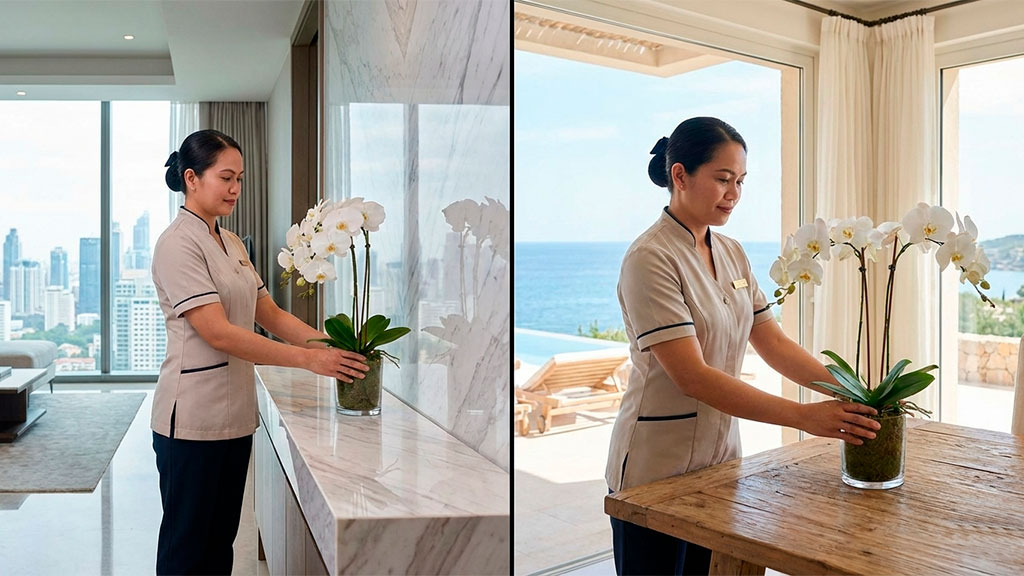
For the high-level property owner, life often unfolds across various geographical coordinates. A primary residence in the city, a summer villa on the coast, a mountain retreat, or an apartment in an international capital. While owning multiple properties is a symbol of freedom and success, managing them can become a source of logistical stress without the right team. The greatest challenge is not just keeping each house in perfect condition, but ensuring that the owner’s transition between them is absolutely invisible and frictionless.
In this complex scenario, Filipino domestic staff have emerged as the most valuable resource for Family Offices and private owners. Their ability to work in a coordinated manner, their unwavering loyalty, and their work methodology allow the “home standard” to remain identical, regardless of the latitude. Filipino staff do not just look after a house; they look after the owner’s lifestyle, acting as a human operating system that guarantees the continuity of well-being across their entire residential portfolio.
Invisible logistics: creating a continuous residential experience
The goal of multi-property management is for the owner to feel they have “arrived home” the instant they cross the threshold of any of their residences. This requires a logistical choreography that happens long before their arrival.
Unified protocols: comfort without borders
The key to successful management lies in standardization. Filipino staff are exceptionally skilled at following and maintaining strict protocols. In a multi-property structure, this means that the order of the dressing room, the arrangement of toiletries, the type of fresh flowers, or even the temperature of the wine cellar must be identical in all houses if so preferred.
By employing staff from the same culture and background under the supervision of Luxury Philippines Domestic Service, it is ensured that there are no “gaps” in service quality. This uniformity reduces the owner’s decision fatigue; they do not have to learn where anything is or explain their tastes again, because their team has already replicated their personal ecosystem in the new location.
Communication channels and the spirit of ‘bayanihan’
Coordination between a house in Madrid and a villa in Marbella requires impeccable communication. The Filipino concept of Bayanihan (teamwork for a common goal) is fundamental here. Staff at the residence of origin communicate with those at the destination to transfer critical information: current dietary preferences, specific wardrobe needs traveling with the owner, or recent changes in health routines. This internal network of trust ensures that information flows without the owner having to act as an intermediary for their own employees.
The filipino profile: the human factor in multi-property management
Managing a property that sometimes remains empty for months requires a level of ethics and autonomy that Filipino staff possess intrinsically.
Polyvalence and geographical adaptability
One of the most valued traits of our professionals is their versatility. In a multi-property environment, needs can change drastically. One week they may be managing formal table service for a gala dinner in the city, and the next, coordinating the maintenance of nautical equipment or tropical gardens at a vacation residence. This capacity for technical adaptation, coupled with their willingness to travel if necessary (the traveling staff model), offers an operational flexibility that very few other nationalities can match with the same level of serenity and efficiency.
Custodians of heritage: the value of ‘malasakit’
When a luxury property is left empty, it is at its highest risk of deterioration due to lack of use or preventive maintenance. This is where Malasakit comes in. Filipino staff do not see the house as an empty workplace, but as a heritage they must zealously protect. Their proactive management involves checking for dampness, airing out rooms, caring for delicate textiles, and ensuring that technological systems remain operational. The owner has the peace of mind of knowing that their investment is guarded by someone who feels a moral duty to care for it as if it were their own, avoiding costly repairs due to negligence.
Operational efficiency and methodology in the shadows
Behind the warmth of Filipino service, there is a very disciplined work structure that is vital for handling the complexity of several houses.
Intelligent inventory and supply management
There is nothing more frustrating for an owner than arriving at their holiday residence and finding their favorite wine is out of stock or an essential product is missing. Filipino staff excel in dynamic inventory management. They use control systems (often digital or through shared lists) to ensure that the pantry and supplies are always at an optimal level before any arrival. This foresight turns the house into a living, ready organism, removing domestic chores from the owner’s agenda and allowing them to fully enjoy their leisure or work time.
Conclusion
Multi-property management is a challenge of scale where technique must join loyalty. Filipino domestic staff represent the ideal pillar for this structure due to their innate capacity for coordination, their respect for protocol, and their deep ethics of care. They are responsible for ensuring that the concept of “home” is not tied to a postal address, but to a constant feeling of peace and order that accompanies the owner wherever they go.
At Luxury Philippines Domestic Service, we specialize in designing domestic teams capable of operating in these high-complexity networks. We understand that your time is your most valuable resource, and our staff is trained to protect it, turning the management of your residences into a symphony of efficiency, discretion, and cultural excellence.