
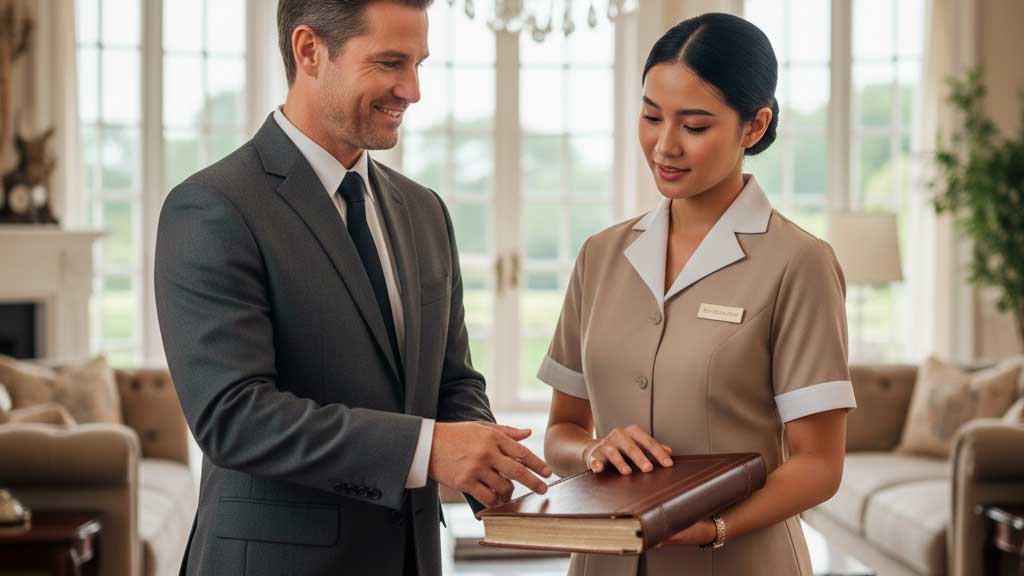
Hiring high-level domestic staff is only the first step toward operational excellence in the home. The true challenge—and where the long-term success of the relationship between the family and the employee is defined—lies in the onboarding process. In the environment of luxury residences, the first 90 days are critical: it is the period where expectations are set, the house culture is absorbed, and mutual trust is forged.
For Filipino staff, whose service culture is deeply linked to loyalty and respect for hierarchy, a structured landing is not just helpful; it is a necessity. A luxury onboarding is not limited to handing over the keys; it is a strategic process that ensures the new professional not only understands their tasks but becomes an organic extension of the family’s lifestyle. In this article, we will analyze how to manage this vital quarter to ensure a seamless integration.
The immersion phase: The first month of cultural adaptation
The first month is a stage of intense observation and learning. During these initial 30 days, the goal is for the new employee to understand the “soul” of the house and the biological and social rhythms of the family.
Establishing clear expectations from day one
Nothing generates more anxiety in a new employee than ambiguity. The first day should begin with a welcome meeting where the House Manual is reviewed and immediate priorities are clarified. For Filipino staff, it is essential to feel they have a solid frame of reference. Clearly defining who their direct superior is and what the official communication channels are (WhatsApp, management apps, or face-to-face meetings) avoids misunderstandings and allows the employee to start executing with confidence.
Knowledge transfer of personal preferences
In luxury residences, what is left unsaid is as important as what is said. The first month should be dedicated to the employee learning subtle habits: how coffee is preferred, the level of privacy required at certain times of the day, or the specific arrangement of personal objects. During this phase, the House Manager or the owner themselves should act as mentors, offering gentle and constructive corrections. Filipino staff are extremely receptive to personalized training, seeing these instructions not as criticism but as tools to achieve excellence.
The consolidation phase: From day 30 to 60
Once the employee masters basic routines and feels comfortable in the physical environment of the property, it is time to deepen autonomy and technical efficiency.
Mastery of infrastructure and home systems
Every great residence has its technical peculiarities. Between the second and third month, the employee should be able to fluently manage home automation systems, industrial laundry machinery, or security protocols without constant supervision. This is the ideal period to conduct specific training with external providers if necessary. For a Filipino employee, mastering the house’s technology is a matter of professional pride, and achieving this autonomy reinforces their commitment to the property.
Mid-term evaluation and two-way feedback
Upon reaching day 45 or 60, it is essential to hold a formal feedback session. This is not just about evaluating the employee’s performance, but about listening to their impressions. Are they missing any tools? Is there a protocol that doesn’t quite fit the day-to-day reality? This open communication prevents burnout and allows for course corrections before small frictions become structural problems. Filipino culture deeply values harmony (Pakikisama), so creating a safe space for dialogue strengthens the emotional bond with the family.
The autonomy and belonging phase: The final 30 days
By the end of the third month, the onboarding should conclude with an employee who not only knows what to do but is capable of anticipating the family’s needs.
Developing proactivity and anticipation
The hallmark of luxury service is the ability to solve problems before the owner even notices they exist. In this final stretch of the 90 days, Filipino staff should have developed enough confidence to suggest improvements in pantry management, propose menus, or reorganize cleaning routines for greater efficiency. When an employee stops asking “what do I do now?” and starts saying “I’ve already taken care of this,” the onboarding has been a success.
Emotional integration and the feeling of loyalty
The last days of the integration process serve to consolidate the sense of belonging. At Luxury Philippines Domestic Service, we know that loyalty is the pillar of domestic service. When staff feel their work is valued and that they are an essential part of the family’s well-being, their level of dedication becomes exceptional. At the end of the 90 days, a small meeting to confirm goals met closes the onboarding cycle, transforming a “new hire” into a trusted member of the household team.
Conclusion
A luxury onboarding is an investment that pays off in years of impeccable service and stability in the home. The first 90 days make the difference between constant staff turnover and a solid, faithful team. By structuring the arrival of Filipino staff with rigor, empathy, and clarity, the family ensures that their investment in human capital flourishes, turning their residence into a space of absolute peace and efficient management.
At Luxury Philippines Domestic Service, we accompany our clients through this critical quarter. We understand that perfect integration is not the result of chance, but of a process designed so that both the family and the staff find their ideal balance. A great start is the foundation of a lasting relationship.