
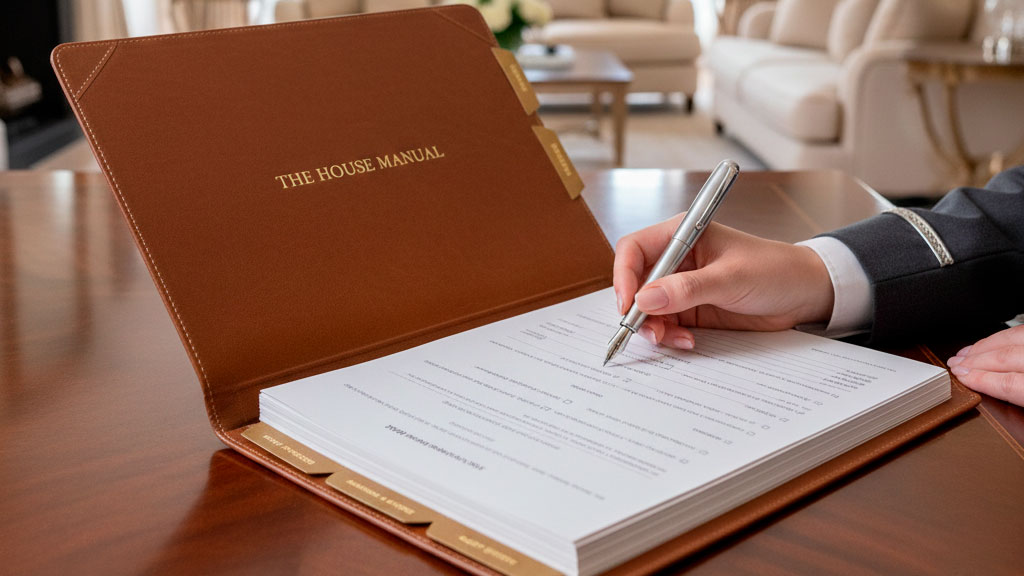
In the management of luxury residences, improvisation is the enemy of excellence. A high-standing property is not just a collection of elegant rooms; it is a complex infrastructure that requires rigorous technical maintenance, specific service protocols, and a special sensitivity toward the owners’ habits. Without a clear roadmap, even the most qualified staff can make mistakes due to a lack of context or ambiguity in instructions.
This is where the House Manual becomes relevant. This document is not a simple set of rules, but the “operating bible” that ensures the home functions with mathematical precision, regardless of who is on shift. For Filipino staff, whose work ethic is based on discipline and meeting high standards, having a detailed manual is the ultimate tool for achieving perfection. In this article, we will explore how to design this document and why it is the pillar of a friction-free home.
The anatomy of a successful manual: essential contents
An effective manual must be exhaustive yet accessible. It is not a book of theory, but a living instruction manual that should be consulted daily to resolve doubts before they become problems.
Welcome protocols and family preferences
The heart of the manual is the personal preferences of the owners. A luxury home is defined by details: the exact temperature the master bedroom should be at nightfall, the specific brand of mineral water on the nightstand, or the exact arrangement of cushions in the living room. Filipino staff excel in their ability to observe, but the manual ensures that this knowledge is not lost. Documenting these “micro-details” allows any new team member to maintain the level of personalization the client expects from day one.
Technical guide for maintenance and home automation
Modern residences are technological milestones. Zoned climate control, smart lighting, perimeter security, and water filtration systems require specific technical knowledge. The House Manual should include a technical section with simplified diagrams, emergency service contacts, and, above all, a preventive maintenance calendar. This way, the staff knows exactly when to check the irrigation system or when to call the elevator technician, avoiding untimely breakdowns that disrupt the peace of the home.
Standardization of service: the filipino quality seal
Consistency is what transforms good service into elite service. The manual allows the “house style” to be uniform, creating an operational signature that the owner recognizes and values.
Standard operating procedures (SOPs) for every room
Every task, however simple it may seem, must have its SOP. How is the table set for an informal breakfast versus a gala dinner? What is the protocol for washing and ironing delicate fabrics like silk or linen? By defining these steps in writing, Filipino staff can execute their tasks with the assurance that they are following the exact method approved by the owner. These standards eliminate the need for constant supervision, granting the staff autonomy based on trust and rigor.
Pantry management and smart procurement
An efficient home never runs out of stock. The manual should define critical stock levels and preferred vendors. For a Filipino chef or housekeeper, having a documented inventory system facilitates purchasing management and ensures that specific cleaning products (necessary for delicate surfaces like marble or exotic woods) are always available. This prevents the use of unsuitable products that could damage the home’s heritage.
Communication and confidentiality: the manual’s ethical code
Beyond the technical, the House Manual sets the foundation for coexistence and the protection of privacy—two fundamental values in Filipino service culture.
Privacy protocols and guest management
The manual must be clear on how to interact with guests and which areas of the house are restricted at specific times. Discretion is the most valued quality in Filipino staff, and the manual reinforces this value by establishing clear rules on taking photographs inside the property or managing packages and couriers. This ensures the residence remains a private and secure sanctuary.
Incident resolution and chain of command
Even in the best-managed home, unexpected issues arise. The manual should dictate the communication flow: Who is reported a water leak at two in the morning? How is a guest’s complaint managed? Defining the chain of command and emergency protocols provides the staff with the serenity needed to act quickly and effectively, always protecting the owner’s interests.
Conclusion
The House Manual is not a static document, but an investment in peace of mind. It represents the transition from reactive to proactive domestic management. When the structure of a well-designed manual is combined with the warmth, loyalty, and skill of Filipino staff, the result is unparalleled operational excellence.
At Luxury Philippines Domestic Service, we recommend the implementation of this “operating bible” to all our clients. It not only facilitates the integration of employees but also protects the property’s value and, most importantly, the owner’s time. A clear manual is the greatest guarantee that, upon walking through your door, everything will be exactly as you wish, without needing to say a single word.