
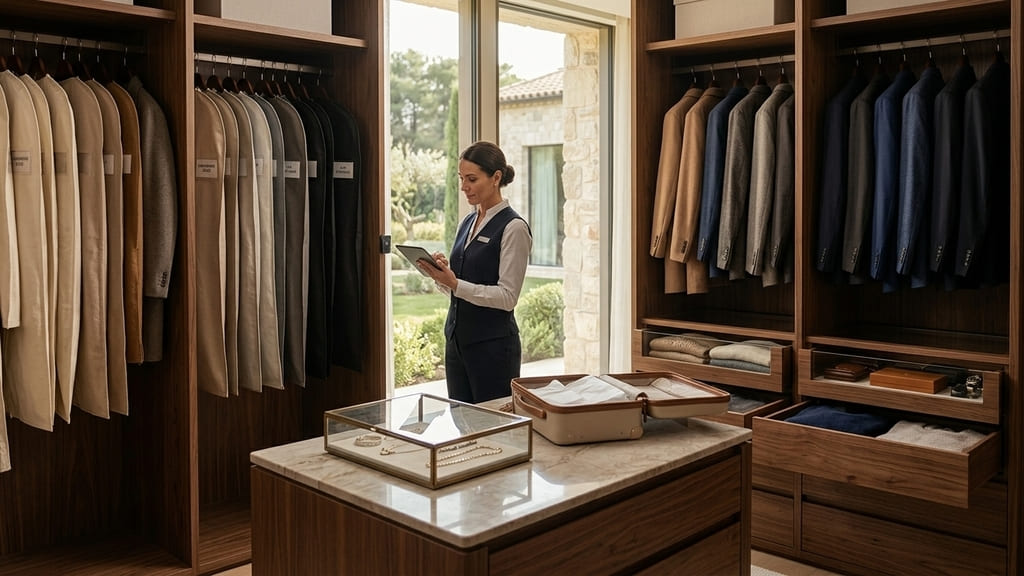
High-end wardrobe management transcends the mere aesthetic organization of garments; it is a discipline of textile heritage conservation. With the change of season, the wardrobes of primary residences must undergo a methodical transition where the preservation of fine fabrics, spatial ergonomics, and digital inventory ensure that every piece of haute couture, bespoke tailoring, or fur retains its original splendor. An advanced Wardrobe Management system executed by specialized personnel guarantees that the dressing room is not only a reflection of elegance, but a functional space perfectly aligned with the social and professional agenda of its owners.
Audit Methodology, Cataloging, and Digital Inventory
Before initiating any physical movement of garments, a rigorous audit is essential to classify the wardrobe. Applying professional protocols prevents deterioration from improper storage and optimizes daily dressing preparation time.
Classification by Typology, Frequency of Use, and Social Etiquette
The process begins with the methodical triage of seasonal collections. Pieces are divided into strict categories: black-tie or evening wear, business suits, high-quality casual wear, and high-performance sportswear. Each category is strategically distributed according to its frequency of use, reserving the most direct access for daily garments while protecting pieces intended for formal events in secondary areas.
Wardrobe Digitalization and Garment Tagging
Modern wardrobe management incorporates digital cataloging tools that allow property owners or personal assistance staff (personal shoppers and house managers) to view complete outfits through private applications. Each garment is photographed, categorized, and indexed using discreet tags or RFID technology, recording details such as:
- Fabric Technical Sheet: Exact composition and specific requirements for dry cleaning or artisanal washing.
- Maintenance History: Dates of tailoring adjustments, repairs, or conservation treatments.
- Exact Location: Identification of the specific section, box, or breathable garment bag where the piece is stored.
Technical Preservation of Fine Fabrics and Furs
Prolonged storage during a garment’s resting months can cause irreversible damage if proper hygrometric and conservation treatments are not applied. High-quality materials require a controlled environment and neutral archival materials.
Hygrometric Conditioning and Natural Pest Control
Humidity and temperature are the most critical variables in textile conservation. A professional dressing room must maintain a stable relative humidity between 45% and 55%, at a temperature between 18 °C and 21 °C (64 °F to 70 °F). To prevent the proliferation of moths and other biological agents without resorting to harsh chemicals that damage fibers, untreated red cedar blocks, organic lavender sachets, and high-precision pheromone traps are utilized.
Conservation Protocols for Wool, Cashmere, Silk, and Furs
Each noble fiber requires a specific folding or hanging technique during seasonal transition:
- Tailoring and Wool or Cashmere Coats: Suspended on wide-shouldered anatomical wooden hangers to maintain the tailor’s structure, protected in 100% breathable, acid-free cotton garment bags.
- Silk and Satin Garments: Stored in opaque garment bags to prevent color degradation from light exposure, using padded silk or soft velvet hangers.
- High-End Furs: Require refrigerated storage vaults with constant air circulation or special cloth garment bags that allow the skin to “breathe” without losing its natural oils.
Spatial Architecture and Continuous Maintenance Protocol
The internal layout of the wardrobe must respond to criteria of symmetry, accessibility, and visual protection. Implementing luxury hospitality standards in the home transforms the daily routine of dressing into a seamless and enjoyable experience.
Aesthetic Layout, Uniform Hanging, and Space Optimization
Visual coherence is fundamental in dressing room architecture. A single pattern of customized fine wood hangers is established, all facing the same direction and separated by identical distances to avoid fabric compression. Color ordering is arranged from light to dark from left to right within each section, providing an immediate sense of harmony and luminosity.
Daily Maintenance Routines and Travel Packing Preparation
The wardrobe staff’s work does not end with the seasonal change. A continuous protocol of brushing garments with natural bristles after each use, airing prior to storage, and artisanal steaming is established. Furthermore, staff master acid-free tissue paper folding techniques for travel packing, ensuring that wardrobes arrive at international destinations wrinkle-free and ready to wear. This obsessive attention to detail and mastery of textile conservation is the hallmark of personnel trained by Luxury Philippines Agency.
Conclusion
Deep wardrobe management is an investment in preserving the family’s textile heritage and enhancing daily efficiency. When digital cataloging, technical fiber conservation, and dressing room aesthetics are masterfully executed by professionals selected by Luxury Philippines Agency, the wardrobe is transformed into a sanctuary of elegance perfectly prepared to meet the demands of the new season.