
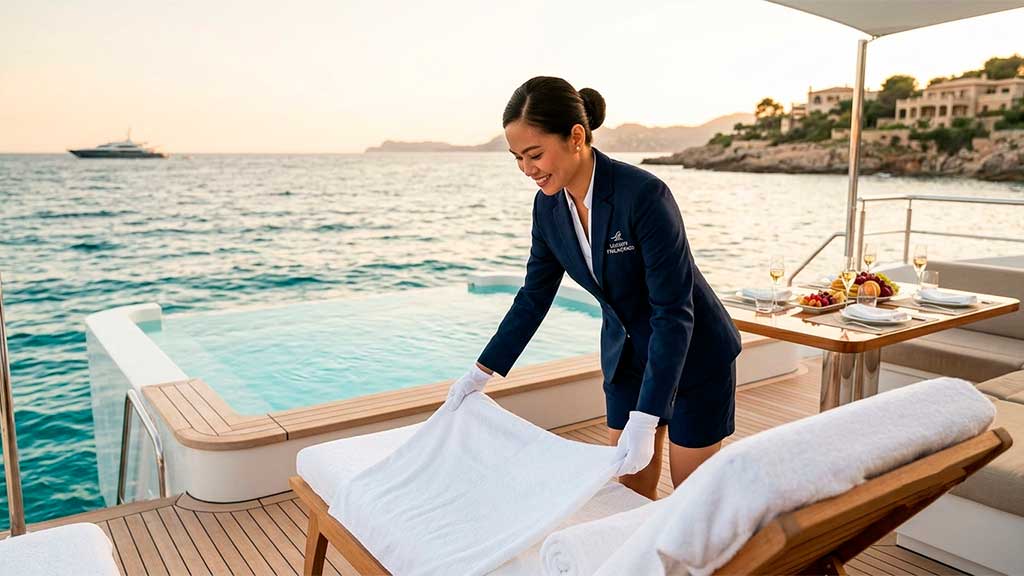
For high-net-worth families and UHNWI (Ultra-High-Net-Worth Individuals) profiles, summer typically unfolds in a very specific environment: the coastline. Whether aboard a private megayacht sailing the Mediterranean or in exclusive front-line beach villas, the summer season demands a seamless transition in lifestyle. However, transferring seven-star residential hospitality standards to a maritime environment is no simple task; it requires operational flexibility and an adaptive capacity that very few domestic management professionals possess.
In this demanding scenario, domestic staff of Filipino origin have established themselves as the preferred and most highly valued choice internationally. Their elite training, combined with a natural cultural affinity for nautical settings and the floating luxury sector, allows them to double their efficiency both on dry land and at sea. This article analyzes how these professionals achieve a flawless adaptation to the dynamics of onboard service and coastal residences, ensuring their principals’ comfort invisibly.
The Duality of Service: Efficiency on Land and Versatility at Sea
Managing a static real estate property is radically different from maintaining luxury standards on a vessel in constant motion. Qualified Filipino domestic staff stand out for their ability to master both worlds without guests perceiving the slightest change in service quality.
Provisioning Logistics and Management of Limited Space
One of the greatest challenges aboard a yacht or in an isolated maritime residence is space and storage management. Unlike an urban mansion, cabins and galleys on vessels demand millimetric order. Filipino domestic staff, accustomed to the protocols of the luxury resort and cruise ship hospitality sectors, apply exhaustive inventory control. They know how to plan provisioning for extended voyages, optimizing cold storage areas and ensuring that delicate, high-end products are perfectly preserved, thus preventing shortages in the middle of the sea.
Adaptation to Nautical Protocol and Maritime Safety
Onboard service requires strict compliance with international nautical regulations and safety protocols that do not exist in the classic residential sphere. Filipino butlers, chefs, and service crew typically hold official maritime safety certifications (such as the STCW) along with rigorous training in first aid and evacuation. Their dexterity in moving elegantly across a shifting deck, combined with their understanding of maritime hierarchies (coordinating seamlessly with the captain and officers), guarantees that comfort never compromises the family’s safety.
Specialized Maintenance Against the Rigors of the Marine Climate
The sea offers idyllic landscapes, but its environment is one of the most aggressive toward noble materials, haute couture fabrics, and the technological infrastructure of a luxury property or vessel.
Salinity Control and Preservation of Noble Materials
Saltpeter, extreme humidity, and constant solar radiation can deteriorate teak wood, marble, stainless steel hardware, and luxury brand upholstery in a matter of days. Qualified staff possess advanced technical knowledge regarding the neutral chemical products and preventive treatments required for each material. They implement daily deep-cleaning and sealing routines that protect the equity value of the yacht or coastal villa, ensuring that spaces always look polished, dry, and with the signature gleam of ultra-luxury standards.
Fine Textile Management and High-Precision Nautical Laundry
The sea breeze infuses garments and bed linens with a salt-laden humidity that requires highly meticulous laundry treatment. Filipino staff, globally recognized for their textile care expertise, adapt their washing, ironing, and drying techniques to the physical limitations of yachts (where dryers and hanging space are restricted). They utilize specific programs for natural fibers such as linen and silk, guaranteeing that summer wardrobes and bedding maintain impeccable freshness, a neutral aroma, and a soft texture, completely free from the harshness of sea salt.
Floating Hospitality: The Art of Discretion in Confined Spaces
Living together on a yacht or in a second holiday residence narrows the physical boundaries between owners and service staff. Maintaining privacy in this context requires exceptional psychological sophistication.
Service Psychology and Invisible Anticipation
In the intimacy of a boat, physical proximity is inevitable. Staff of Filipino origin are globally valued for their service psychology: an innate ability to read the environment, anticipate guests’ needs before they voice them, and, at the same time, become “invisible” when the family requires privacy. They know precisely when to strategically withdraw and when to appear with a refreshing drink or a dry towel, maintaining a warm yet strictly professional presence that eases the tension of confinement in reduced spaces.
Conclusion
The success of a summer season by the sea depends on a service machinery that functions flawlessly, regardless of the logistical challenges imposed by the ocean. By entrusting the selection and backing of these profiles to Luxury Philippines Domestic Service, owners ensure an impeccable transition between land and sea. Incorporating qualified Filipino staff on yachts and second maritime residences represents the safest investment for those who refuse to compromise their standard of living during the holidays. Thanks to their technical versatility, resilience, and deep respect for etiquette protocol, these professionals ensure that the coastal stay is an experience of absolute comfort, exclusivity, and tranquility.