
In ultra-luxury interior design, the focus has traditionally been placed on aesthetics and materiality. However, a new discipline is transforming our understanding of the home: neuroarchitecture. This science studies how the physical environment directly affects our brain functions, cortisol levels, and emotional well-being. A cluttered or poorly managed space is not just visually annoying; it is a chronic stressor that keeps the brain in a constant state of alert.
Staff of Filipino origin, with their innate capacity for meticulous organization and sensitivity to detail, act as the “invisible architects” of emotional well-being in grand residences. They do not merely clean; they apply environmental design principles that optimize the space to reduce the owner’s cognitive load. In this article, we analyze how their work methodology aligns with the principles of neuroarchitecture to create sanctuaries of mental peace.
The science of space: reducing cognitive load
The human brain seeks patterns and order to save energy. When we enter a room where objects are out of place, our visual system processes an excess of irrelevant information, which increases mental fatigue.
“Visual quiet”: visual silence for brain rest
Filipino staff are experts in creating what neuroarchitects call “visual quiet.” This does not mean extreme minimalism, but rather the strategic management of objects. By applying symmetry and alignment techniques, they ensure the eye glides across the room without interruption. By eliminating visual noise, the owner’s brain stops processing unnecessary stimuli, facilitating an immediate transition from a work state to a relaxation state upon arriving home.
The psychology of clear surfaces
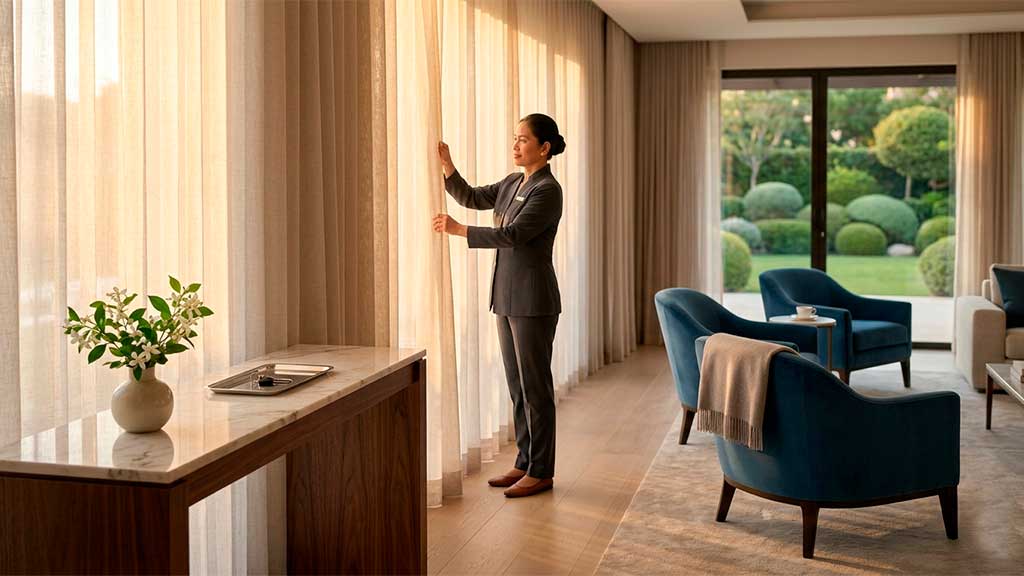
There is a direct correlation between clear surfaces and clarity of thought. An entry console free of keys, mail, or accumulated clutter sends a “mission accomplished” signal to the hypothalamus. Filipino staff apply rigorous discipline in maintaining common areas, ensuring that every surface reflects order. This small architectural detail reduces levels of cortisol—the stress hormone—almost instantaneously.
Light management and circadian rhythms
Neuroarchitecture grants vital importance to light. High-level domestic staff understand how lighting affects mood. They know when to open curtains to take advantage of morning blue light (which activates serotonin) and when to prepare the house with warm, indirect lights at dusk to favor melatonin production. This management of “lighting design” ensures the owner’s biological cycle is in perfect harmony with their surroundings.
Order as an emotional security system
Order is not a static state, but a dynamic process. Filipino staff implement systems that transcend superficial cleaning, creating an environment of predictability that calms the nervous system.
Micro-organization: the pleasure of predictability
The brain loves predictability because it reduces the perception of threat. Knowing exactly where every object is—from a phone charger to favorite cufflinks—eliminates the “micro-frictions” of daily life. Filipino staff take organization to an almost surgical level in dressing rooms and pantries. This invisible structure provides the owner with a sense of control over their environment, which is a powerful antidote to executive anxiety.
Environmental aromatherapy and the limbic system
The sense of smell has a direct line to the limbic system, the brain’s emotional center. Filipino staff often integrate subtle, natural fragrances that reinforce the identity of the home as a safe space. Using citrus scents for morning energy or lavender for night-time rest is a practical application of how staff use sensory design to positively influence the neurochemistry of the household.
Flow of movement and domestic ergonomics
A poorly managed house creates physical obstacles that interrupt the natural flow of movement. Elite domestic staff observe how owners move through the space. If they notice a piece of furniture or an arrangement of objects hinders the path, they readjust the environment to favor fluid circulation. In neuroarchitecture, an unobstructed flow of movement is linked to a lower sense of spatial overwhelm.
Biophilia and thermal comfort: healing details
Connection with nature and the maintenance of physical comfort are pillars that Filipino staff masterfully handle to improve the owner’s mental health.
Caring for interior nature (biophilia)
Biophilia is the innate human affinity for living systems. It has been shown that the presence of healthy plants reduces blood pressure and improves concentration. Filipino staff possess a special talent for botanical care, ensuring that floral arrangements and indoor plants are always at their optimal point of vitality. A withered plant is a reminder of neglect; a lush plant is a reminder of life and care.
Thermal and acoustic balance
Thermal comfort is essential for emotional self-regulation. Filipino staff anticipate climatic needs: they prepare bedrooms with the ideal temperature before the owner retires to rest and ensure adequate ventilation to avoid stale air. Likewise, they manage ambient noise—avoiding the use of heavy machinery or vacuum cleaners during rest periods—protecting the acoustic peace of the home, which is vital for neuronal regeneration.
The aesthetics of care: the value of impeccable detail
Finally, neuroarchitecture tells us that beauty and perceived care generate dopamine. Seeing a bed perfectly made with the “hospital corner” technique or a table set with millimetric precision is not just luxury; it is a visual signal that the environment is safe and under control. The rigor of Filipino staff in these details creates a “halo effect” of well-being that envelops the entire experience of inhabiting the home.
Conclusion
True exclusivity in the 21st century lies not only in the value of materials but in the quality of the mental experience a space provides. Filipino staff do not just manage tasks; they manage moods through order and environmental design.
At Luxury Philippines Domestic Service, we understand that a home must be a recovery tool for the owner. By selecting professionals who intuitively apply the principles of neuroarchitecture, we offer more than just a cleaning and organization service; we offer a mental health strategy. An environment under the care of our staff is an environment where stress dissolves, allowing the brain to rest, recover, and flourish at its maximum potential.