
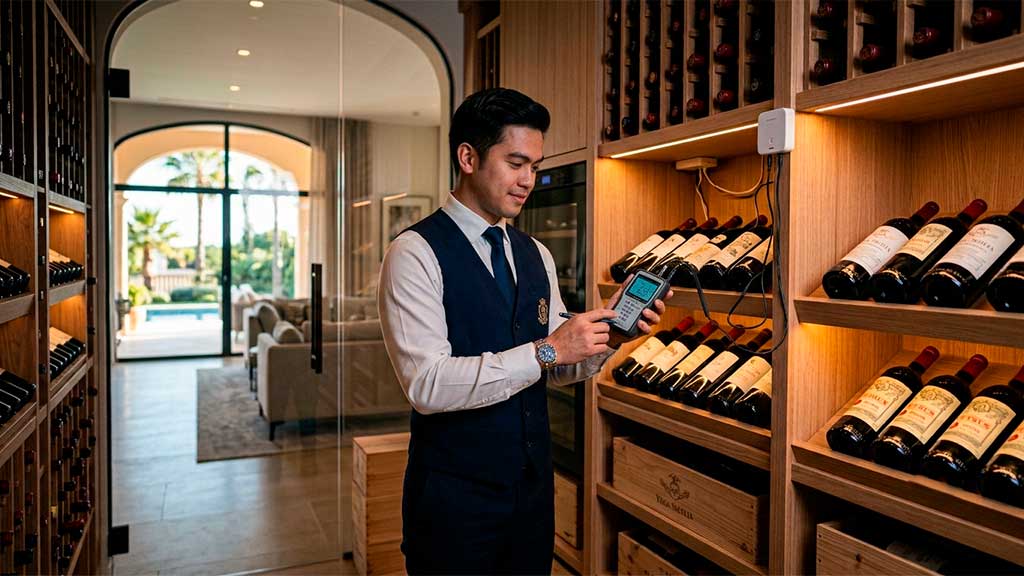
The heritage of a grand residence extends far beyond its architecture or primary furnishings. In high-end properties, true treasures often take the form of private vintage wine collections, priceless works of art, rare haute couture leather goods, or collectible cigar humidors. During the summer months, extreme high temperatures, fluctuating ambient humidity, and prolonged sun exposure present a critical challenge to the preservation of these goods. Achieving rigorous control over these variables without disrupting the family’s routine demands an impeccable blend of cutting-edge technology and technical management executed by highly trained professionals.
The Summer Thermal Impact on High-Value Assets and Heritage
The weather variations typical of the warm season constitute the main invisible enemy of high-value objects. Accelerating heat and a lack of atmospheric regulation can cause irreparable damage in a matter of days or even hours if there is no constant supervision.
Chemical and Physical Vulnerability of Fine Wine and Art
Wine is a living organism in constant evolution. Temperatures above 16 °C artificially accelerate its aging process, alter its aromas, and can deteriorate the cork, allowing unwanted oxygen to enter. Similarly, works of art—especially oil canvases, wooden sculptures, and paper-based works—undergo abrupt contractions and expansions when faced with thermal changes. Relative humidity stability (ideally between 55% and 65%) is just as crucial as a constant temperature to prevent tension in pigments or the appearance of mold on organic supports.
The Risk of Microclimate Fluctuations in Unoccupied Residences
During periods when the property remains empty or is under partial use during vacations, the internal microclimates of the rooms can quickly become unbalanced. The unexpected failure of an HVAC unit, a temporary power outage, or an interruption in airflow within closed rooms can drastically raise humidity levels in subterranean areas or overheat exhibition rooms. Active prevention requires that the home never remain unattended from a technical and operational standpoint.
Technical Monitoring Protocols and Daily Collection Supervision
To protect these assets with surgical precision, intuition must be replaced by methodical verification protocols. Technology provides the data, but the human factor is responsible for interpreting, verifying, and reacting swiftly to any anomaly.
Implementation of Precision Sensors and Integration into Smart Home Systems
Modern preservation relies on high-fidelity, continuous environmental monitoring systems:
- IoT Temperature and Humidity Sensors: Wireless devices calibrated with thousandths-degree precision that record wine cellar or art room conditions in real time.
- Automated Threshold Alerts: Immediate notifications configured for any variation greater than 0.5 °C or a 2% deviation in relative humidity.
- Uninterruptible Power Supply (UPS) Systems: Dedicated generators and batteries ensuring that cellar climate control and dehumidifiers continue operating during power outages.
Manual Verification, Asset Rotation, and Lighting Control
Despite automation, daily physical inspection is irreplaceable. Methodical supervision ensures an optimal environment through direct actions:
- Visual Inspection and Cross-Checked Readings: Direct physical verification of hygrometers against digital sensor readings to rule out calibration errors.
- Lighting and UV Ray Management: Ensuring automated shades and UV-filter glass block 100% of direct sunlight, using cold-spectrum LED lighting only when access is essential.
- Humidor and Cellar Monitoring: Checking distilled water or propylene glycol solution levels in cigar humidors to maintain a constant 70% humidity level.
The Human Factor in High-Value Asset Preservation
Having the best technology is meaningless if the estate staff lacks the proper training to handle, care for, and supervise these delicate items.
Technical Training and Operational Sensitivity of Household Staff
Managing these assets demands a methodical, meticulous team endowed with a deep sensitivity for detail. The staff must understand the importance of not altering a cellar’s microclimate by leaving a door cracked open, the delicacy required to dust a console without touching an adjacent sculpture, or the exact temperature at which a gourmet pantry must be kept.
Conclusion
Protecting a home’s material heritage does not rely on chance, but on a constant commitment to operational excellence. When technical supervision is executed with discipline and invisibility by professionals such as those selected by Luxury Philippines Agency, the owner enjoys absolute peace of mind. Preserving the value of great private collections during the summer is, ultimately, ensuring that the legacy of the home remains intact over time.