
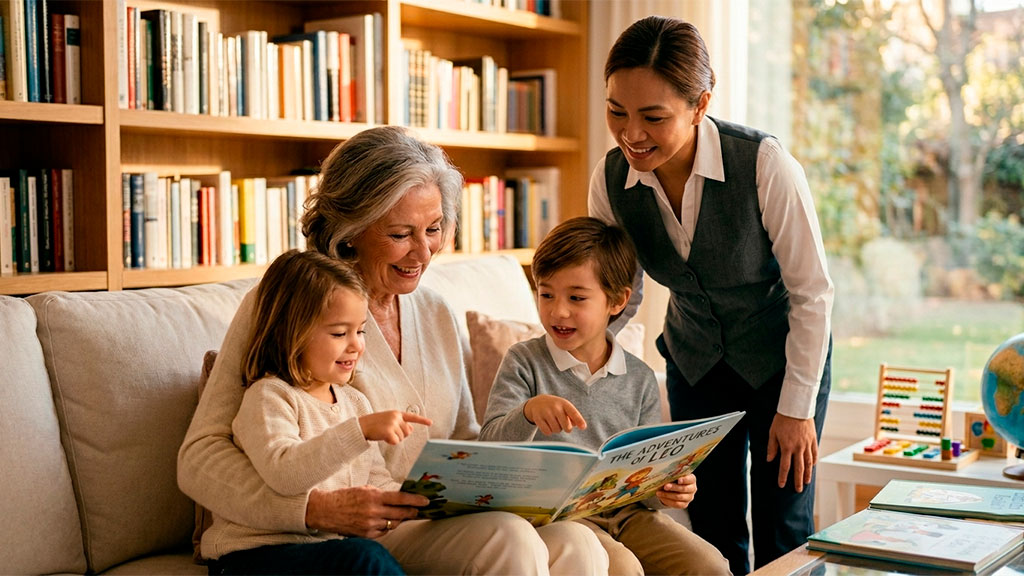
In the environment of high-profile families, raising children is not just a matter of physical care, but a comprehensive development project that seeks to enhance cognitive, linguistic, and emotional capabilities from early childhood. The choice of support staff, nannies, governesses, and caregivers, becomes, therefore, a strategic decision.
Filipino personnel have established themselves as the global benchmark in this field. Their influence goes far beyond daily supervision; they act as socialization agents who bring a unique combination of affective warmth, structured discipline, and a fundamental competitive advantage: linguistic immersion in English. In this article, we will explore how the presence of Filipino professionals in the home not only facilitates family logistics but also deeply enriches the cultural and educational capital of the children.
Organic bilingualism: a competitive advantage from the cradle
In a globalized world, mastering English is no longer an option but a basic requirement. The greatest pedagogical advantage of having Filipino staff is the ability to foster natural and effortless bilingualism.
Linguistic immersion in the domestic setting
Unlike private academic classes, which can be tedious for a child, interacting with a Filipino nanny allows English to be integrated into daily life. From playtime to hygiene routines or meals, the child is exposed to a rich vocabulary and grammatical structure organically. This “acquisition” of language, as opposed to formal “learning,” allows the child to develop fluent pronunciation and an instinctive understanding that will last a lifetime.
Support for schoolwork and academic reinforcement
The Philippines possesses one of the strongest educational systems in Southeast Asia, with a robust Western academic heritage. The staff selected by Luxury Philippines often have university backgrounds (in many cases in Education or Nursing), which allows them not only to care but to tutor. They are capable of supervising homework, explaining math or science concepts in English, and preparing children for the standards required by the most prestigious international schools.
Fostering reading habits
Filipino staff deeply value education as a driver of progress. This attitude is transferred to children through the promotion of intellectual activities. It is common for them to establish reading routines before bed or during free time, transforming passive screen consumption into the development of imagination and reading comprehension in a second language.
Emotional development: the value of “structured warmth”
Cognitive development is nothing without a solid emotional foundation. The parenting model provided by Filipino staff is based on what psychologists call “secure attachment.”
Values of respect, gratitude, and courtesy
Filipino culture places an extraordinary emphasis on respect for elders (mano po) and courtesy. By living with professionals of this nationality, children absorb these values vicariously. They learn the importance of good manners, gratitude, and kindness toward others—qualities that are the hallmark of any young person belonging to an elite family.
Stability and routines: the basis of child security
Filipino discipline is gentle but firm. They know that a child needs predictable routines to feel secure. High-level domestic staff are experts in implementing sleep, eating, and study schedules without the need for authoritarianism, using patience and positive reinforcement. This stability is crucial in homes where parents, due to professional commitments, may have irregular schedules.
Resilience and creative play
Filipino staff possess an innate creativity for play. In an environment where children are surrounded by technology, Filipino nannies often propose manual activities, outdoor games, and dynamics that foster problem-solving and patience. This quality human interaction is fundamental for the development of the prefrontal cortex and the management of frustration.
Safety and health: technical training as a guarantee
When it comes to children, trust is based on the ability to respond to any eventuality. The training of Filipino staff offers absolute peace of mind for parents.
Knowledge in nutrition and first aid
Many of the Filipino staff working in the luxury sector have basic or advanced knowledge in first aid and pediatrics. Additionally, their understanding of hygiene and nutrition ensures that children follow balanced diets and stay in hygienically impeccable environments. They understand the importance of prevention and know how to act with serenity and effectiveness in the face of a minor accident or discomfort.
The bridge between school and home
Domestic staff often act as the first filter of information for parents. They know how to observe changes in a child’s behavior, detect learning difficulties, or notice symptoms of physical discomfort, communicating it professionally and discreetly. This constant vigilance ensures that any problem is addressed early.
Conclusion
The influence of Filipino staff on child development is a gift that pays dividends in the long term. It is not simply about “babysitting”; it is about molding the citizens of tomorrow with a bilingual mindset, a balanced emotional foundation, and solid human values.
At Luxury Philippines Domestic Service, we understand that your children are your most important legacy. Therefore, we carefully select profiles that are not only excellent professionals but role models who bring joy, education, and safety to your home. Having the support of a Filipino professional is an investment in your children’s future, providing them with the necessary tools to excel in a demanding world without giving up the warmth and affection of exceptional upbringing.